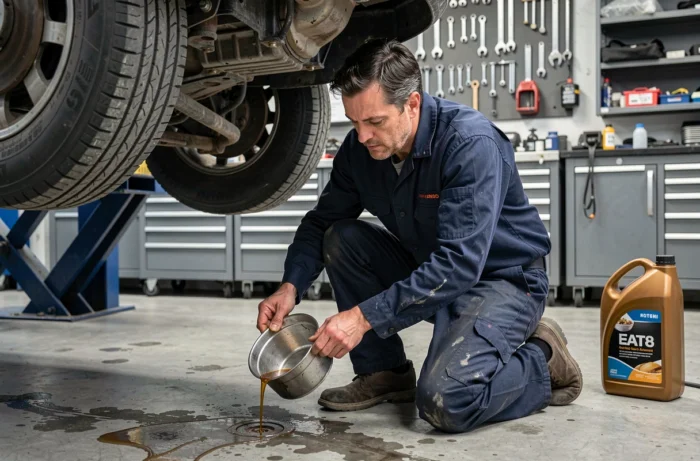
The EAT8 automatic transmission, designed by Aisin and installed on many Stellantis models, features eight gears and a hydraulic torque converter. The manufacturer often presents it as a maintenance-free transmission. Aisin, on the other hand, recommends regular fluid changes, which creates a discrepancy that many owners discover too late.
EAT8 thermal and e-EAT8 plug-in hybrid: two transmissions, two approaches
A rarely discussed point concerns the difference between the EAT8 transmission that equips thermal engines and the e-EAT8 variant for plug-in hybrids. The architecture, torque capacity, and fluid specification can vary from one version to another.
On a plug-in hybrid, the electric motor integrated into the transmission alters the thermal and mechanical stresses experienced by the oil. Using fluid designed for the thermal version on an e-EAT8 (or vice versa) can impair the operation of the solenoids, the electric valves that control gear shifts.
Before any intervention, it is essential to accurately identify the transmission specification. This information is found on the engine label or in the vehicle’s technical documentation. A reputable workshop will check this point, but an owner who buys their oil in advance must do it themselves. The cost of the EAT8 transmission fluid change depends notably on this specification, as the fluid volume and procedure differ.
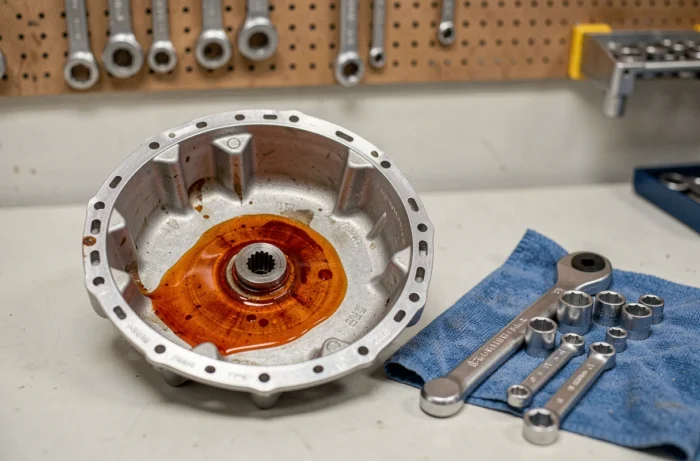
Frequency of EAT8 transmission fluid change based on actual usage
The commonly accepted working basis is between 60,000 and 80,000 kilometers. This benchmark corresponds to mixed usage, without any particular strain. Several situations necessitate shortening this interval.
- Short urban trips continuously stress the torque converter, raising the fluid temperature and accelerating its degradation.
- Towing or transporting heavy loads increases shear forces in the oil, reducing its lubrication capacity.
- On a plug-in hybrid, the transition phases between the thermal engine and the electric motor generate specific thermal cycles that wear the fluid differently.
Waiting for symptoms (jerking, hesitation during cold starts) to change the fluid means intervening after mechanical wear has begun. Transmission fluid does not merely lubricate: it actuates the solenoids and regulates temperature. When it is laden with metallic particles, these functions gradually degrade.
Electronic diagnosis before fluid change: a step often overlooked
Harsh gear shifts do not always mean that the oil is to blame. The transmission control unit may require a software update, and replacing the fluid without checking this point sometimes leaves the symptom unchanged.
An electronic diagnosis allows reading the fault codes stored by the control unit and checking if a software fix is available. This step takes a few minutes with the appropriate tool, but it prevents paying for an unnecessary fluid change or, worse, mistakenly concluding that the transmission is faulty.
Fluid level check: not just a simple gauge
On the EAT8 transmission, the level is checked with the engine running and at a precise fluid temperature, measured using a diagnostic tool. A cold check or with the vehicle stopped skews the reading, even if the amount of oil poured is correct.
This constraint explains why a check in a well-equipped workshop is preferable to a self-check. The target temperature is defined by the manufacturer and varies depending on the transmission specification.

Static or dynamic fluid change: choosing the right method
The dynamic fluid change, performed with a dedicated machine, renews almost all of the fluid by circulating it through the system. The static fluid change, by simple gravity, only replaces part of the oil (that contained in the lower pan).
The common reflex is to favor the dynamic change for its superior efficiency. A static change is sometimes more suitable for a transmission with an unknown history. If the fluid has never been changed on a high-mileage vehicle, the sudden introduction of new oil can dislodge deposits and cause a solenoid blockage.
The method should be chosen after a diagnosis rather than based solely on price. A workshop that systematically offers dynamic changes without asking about the vehicle’s history warrants some caution.
Cost of an EAT8 transmission fluid change
The observed rates range from 290 to 950 euros depending on several factors: type of change (static or dynamic), required oil volume, whether or not the filter and pan are replaced, and labor time. The internal filter, when accessible, represents an additional cost but extends the life of the new fluid.
- Static change only: lower range, quicker intervention, partial fluid renewal.
- Dynamic change with filter replacement: upper range, complete renewal, suitable for vehicles regularly serviced.
- Prior electronic diagnosis: modest cost, but necessary to guide the choice of method.
Resetting the control unit after EAT8 transmission fluid change
Once the fluid is replaced, the transmission control unit retains in memory the adaptation parameters calibrated to the old oil. Without a reset, the transmission may exhibit erratic behaviors for several hundred kilometers, until the system recalibrates itself.
The electronic reset, performed with a compatible diagnostic tool, forces the control unit to restart its learning process from scratch. Gear shifts become smooth again more quickly. Any workshop that performs an EAT8 transmission fluid change without offering this step leaves the job half done.
Maintaining the EAT8 transmission is not just about replacing fluid. It is a chain of technical decisions: identifying the correct transmission specification, diagnosing before intervening, choosing the appropriate fluid change method based on history, checking the level at the correct temperature, and then resetting the control unit. Skipping even one of these steps reduces the benefit of all the others.