
The oral exam for the CPE competition assesses much more than just recited knowledge. Since the reform of teacher training, the admission tests emphasize the analysis of professional situations, discernment, and knowledge of the educational system. Therefore, succeeding in the oral exam for the CPE competition requires preparation that goes beyond simple speaking practice. Here are ten concrete tips, derived from institutional expectations and field feedback.
1. Analyze the jury reports before any revision
The jury reports published after each session detail recurring mistakes and valued qualities. They are the most reliable source for understanding what the jury really expects during the oral exam.
Instead of starting with thematic notes, read the last two or three reports available on the site devenirenseignant.gouv.fr first. Note the phrases used by the examiners to describe a good paper or a good performance. These phrases guide the way you structure your answers on the big day. Among the most overlooked tips for succeeding in the CPE oral exam, this preliminary reading remains the most cost-effective leverage for time invested.
2. Master the institutional framework of the educational system

The jury evaluates your ability to situate the CPE’s actions within the organization of the school. Knowing the regulatory texts (CPE mission circular, competency framework) is not optional.
The oral topics tend to value concrete knowledge of the educational system rather than the recitation of general concepts. Prepare concise notes on the bodies (disciplinary council, CESC, CVL), school life arrangements, and external partners. A candidate who articulates their response with a precise regulatory text stands out immediately.
3. Practice analyzing professional situations under time constraints

The situational study exam requires structured reasoning produced in a limited time. The challenge is not finding ideas but prioritizing them under pressure.
Practice with a timer and a topic drawn from past papers. First, diagnose (what problem, who are the actors, what is the context), then possible responses, and finally the limitations. The jury expects professional discernment, not a list of ideal solutions. Repeat this exercise at least once a week throughout the preparation period.
4. Build a coherent professional journey for the interview

The interview exam focuses on your background and motivations. The jury seeks to understand why you are pursuing this profession and how your previous experiences inform your project.
Prepare a narrative that connects your studies, internships or experiences in school life, and your vision of the CPE role. Each mentioned element should serve the demonstration. Avoid a chronological inventory; favor three or four significant experiences that you can elaborate on if the jury questions you.
5. Work on paraverbal communication with recordings

Speech rate, volume, pauses, and posture influence the jury’s perception, sometimes as much as the content. Articulating and modulating your voice are skills that can be developed.
Recording yourself on video remains the most effective way to identify speech tics, distracting gestures, or a too-fast pace. Watch yourself in real conditions (standing or sitting, with your notes) and correct one flaw at a time. Two weeks of regular practice are enough to see a significant improvement.
6. Prepare thematic notes by competency from the framework
The CPE competency framework structures the jury’s expectations. Organizing your revisions around this framework ensures that no blind spots are left.
Each note should contain a reminder of the text, two or three concrete situations illustrating the competency, and possible limits or tensions. Short, targeted notes are better than exhaustive files that you will never reread the night before the exam.
7. Simulate the oral exam with a third party acting as the jury
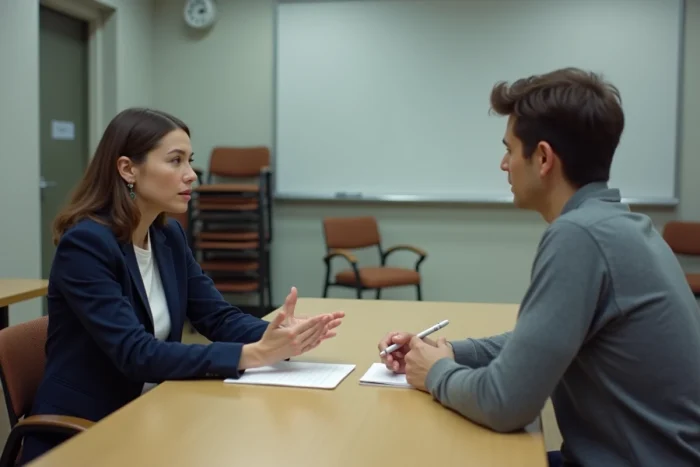
Realistic situational practice, facing someone who asks unsettling questions, prepares you to handle the unexpected. No solitary revision can replace this exercise.
Ask a colleague, trainer, or peer to challenge you on identified weak points. Provide them with the evaluation grid of the competition so they can give precise feedback. Candidates who have practiced several simulations report a significant reduction in stress on the exam day.
8. Learn to rephrase the jury’s questions before answering

Rephrasing the question posed by the jury before answering serves three functions: verifying that you have understood, gaining a few seconds for reflection, and demonstrating your listening ability.
This technique avoids going off-topic, which is among the most frequently reported mistakes in jury reports. A brief rephrasing (“If I understand correctly, you are asking me about…”) is sufficient. It structures your response and reassures the examiner about your rigor.
9. Anchor each response in a concrete educational situation
The juries penalize overly abstract answers. Each argument gains credibility when it is based on a specific example drawn from your experience in a school or your professional readings.
Compile a repertoire of situations experienced or observed during internships, categorized by theme (absenteeism, bullying, guidance, parenting). During the oral exam, use these examples to illustrate your reasoning. A candidate who describes a real situation shows that they already have a professional stance.
10. Manage the last hours before the exam without revising

The day before and the morning of the exam, last-minute revisions create more anxiety than they provide knowledge. The work is either done or it is not.
Only reread your journey notes and the structure of your presentation. Arrive early, familiarize yourself with the locations, and breathe. The jury immediately perceives a calm candidate, and this serenity contributes to the quality of your communication throughout the exam.
Succeeding in the oral exam for the CPE competition relies on a balance between institutional mastery, analytical ability, and presence before the jury. None of these three pillars compensates for the absence of the others. The most effective preparation is the one that works on them together, week after week, until the day of the exam.