Thanking someone on social media seems spontaneous and warm. A public post to say thank you after a gift, support, or presence during a difficult time comes from good intentions. However, this gesture sometimes exposes the relationship, the context, or the gift itself to an audience that neither the sender nor the recipient truly controls.
Private message or public post: what each channel really exposes
The question rarely arises before posting, and this is precisely where the problem begins. A public thank you on Facebook or Instagram shows everyone what someone has given, in what context, and at what time. A guide published by metlivi.com in August 2026 recommends sending a private thank you first if the gift or gesture may reveal sensitive information, then only reposting a neutral visual, with the consent of the person involved.
This logic applies well beyond material gifts. Publicly thanking a friend for their support during a difficult time can reveal a personal situation. Expressing gratitude to a colleague for professional help can expose an internal dynamic that the company would prefer to keep discreet.
Writing a thank you card for a death remains one of the most personal gestures, and sending it by mail protects both the recipient’s privacy and the dignity of the moment experienced.
| Criterion | Public post (social media) | Private message (WhatsApp, email, SMS) | Paper thank you card |
|---|---|---|---|
| Audience | Friends, followers, algorithm | Recipient only | Recipient only |
| Persistence | Indexed, shareable, capturable | Removable, little indexed | Kept or discarded at will |
| Context exposure | High (photo, tag, comments) | Low | None |
| Text personalization | Limited by short format | Free but often quick | Free, thoughtful |
| Recipient’s perception | Flattering but sometimes awkward | Appreciated, discreet | Touching, memorable |

Thanking on social media: situations where a public post is problematic
Not all situations are equal. A public thank you after a professional event (conference, collaboration) usually goes well. However, certain contexts make a public post delicate, even counterproductive.
- After a bereavement: sharing gratitude for condolences received can expose people who do not wish their supportive gesture to be made visible. Grief calls for discretion, not virality.
- After a personal gift: mentioning or photographing a present on Instagram can create discomfort for the giver, especially if the value of the gift becomes a topic of comments.
- In a medical or family context: publicly thanking a loved one for their help during a hospitalization or separation reveals a situation that the recipient may not want to make public.
A poorly calibrated thank you can have unexpected repercussions: tagging a colleague in a personal context can blur the boundaries between private and professional life.
Thank you card and private message: why the personal gesture prevails
A thank you message on WhatsApp or by email reaches the recipient directly. There is no staging, no likes to count, no distracting comments. The kindness of the gesture is not diluted by the format.
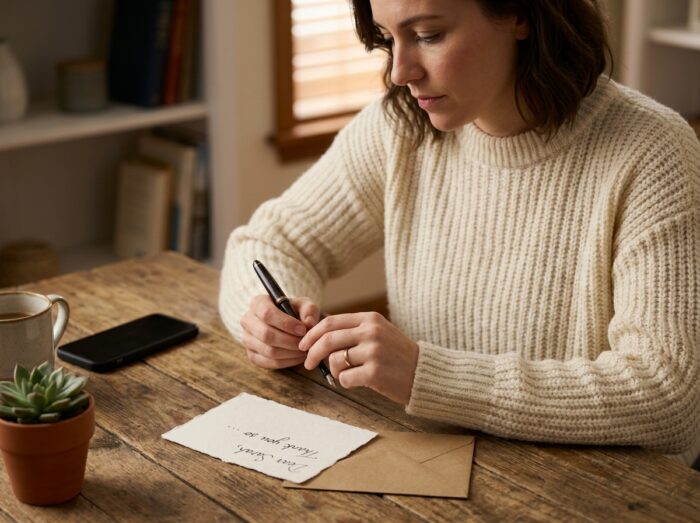
The paper thank you card goes even further. It requires time, a careful choice of words, a physical effort (writing, sending). This invested time constitutes the message as much as the words themselves. In significant life moments (birth, marriage, bereavement), the card remains the medium that recipients keep.
The text of a card also allows for nuanced recognition. On social media, the format pushes for a short and generic formula. In a card, one can detail why someone’s presence mattered, what their gesture concretely changed. The depth of the thank you depends on the chosen medium.

Thanking well online: reflexes to adopt before posting
If a public thank you remains relevant (thanking an association, a professional partner, a community), a few reflexes can help avoid awkwardness.
- Check that the person being thanked is okay with being tagged or mentioned. A quick message beforehand is sufficient.
- Do not publish a photo of the gift, letter, or check received. A neutral visual (flowers, landscape) accompanied by a text of gratitude serves the same function without exposing anything.
- Prefer a private message first, then a public post later if the person gives their consent, as recommended by the guide from metlivi.com.
- Adapt the channel to the context: a bereavement, illness, or breakup calls for a private message or card, never a post.
The text of the thank you matters as much as the channel
Regardless of the medium chosen, a vague thank you (“thanks for everything,” “so grateful”) has less impact than a specific text. Naming the gesture, explaining how it touched, mentioning a concrete detail: this is what transforms a polite message into a moment of shared happiness.
On social media, the temptation to copy and paste is strong. Generic thank you messages all look alike and lose their strength. Taking five minutes to personalize the text, whether on a card, in an email, or in a WhatsApp message, changes the recipient’s perception.
The reflex to post a public thank you is not bad in itself. But the quickest channel is not always the most respectful. Before clicking “publish,” asking whether the recipient would prefer to receive this thank you in their mailbox rather than in their news feed is often enough to make the right choice.