
The hedge trimmer market includes corded electric tools, battery models, and gas versions. Each technology targets a different garden profile and level of requirement. Choosing the best hedge trimmer involves going beyond just the power question to examine battery repairability, tool compatibility, and the actual cost over several seasons of use.
Battery Repairability: A Criterion Ignored by Product Sheets
Most comparisons rank cordless hedge trimmers by autonomy or voltage. They overlook a point that will change the game in the short term: the ability to replace the battery yourself.
The European regulation on batteries stipulates that from February 18, 2027, portable batteries integrated into many devices must be removable and replaceable by the user, subject to exceptions. For a hedge trimmer purchased today, checking now if the battery pack can be disassembled without special tools allows for anticipating this requirement.
This same regulation requires manufacturers to guarantee the availability of replacement batteries for at least five years after the last unit of the model is placed on the market. A hedge trimmer for which the manufacturer no longer sells compatible batteries after three years becomes premature waste, regardless of the condition of its motor. Before purchasing, consulting spare parts catalogs on taille-bordure-warrior.com provides an initial indication of the manufacturer’s follow-up policy.
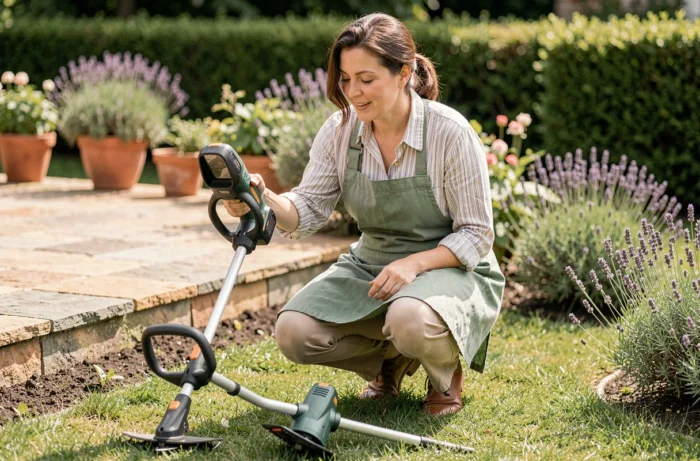
Shared Battery Among Garden Tools: Calculating the Real Cost
A cordless hedge trimmer sold “bare” (without battery or charger) costs significantly less than the complete kit. This option only makes sense if the gardener already owns a tool from the same battery platform.
Several manufacturers offer ranges where a single battery powers a lawn mower, blower, hedge trimmer, and hedge trimmer. A common battery system can halve or even third the accessory budget across all tools. The opposite is also true: buying a hedge trimmer from a different brand than the rest of your equipment forces you to finance an additional charger and battery, sometimes for just a few hours of use per month.
Voltage compatibility is not enough. Two batteries of the same voltage but with different connectors are not interchangeable. The only reliable reference is the name of the platform (the range) indicated by the manufacturer, not the voltage number.
Electric, Gas, or Battery Hedge Trimmer: Which Motor for Which Garden
The type of motorization is not a detail of comfort. It affects the weight, noise, maintenance, and effective usage area of the device.
Corded Electric Hedge Trimmer
A corded model provides constant power without autonomy limits. Its constraint is physical: the cable restricts the range to the length of the extension cord. In an area of less than a few hundred square meters, with accessible outdoor outlets, this limit is not significant.
The weight is generally lower than that of gas models, which reduces fatigue during long finishing sessions around flower beds and lawns.
Battery Hedge Trimmer
The cordless option is suitable for medium-sized gardens where the border runs along paths, walls, or flower beds far from any outlet. Autonomy depends on the battery capacity (expressed in amp-hours) and the thickness of the vegetation being cut.
A often-overlooked point: the charging time. On some entry-level models, recharging the battery takes longer than the usage duration. Checking the charge time / work time ratio avoids unpleasant surprises in the peak season.
Gas Hedge Trimmer
Gas models deliver more torque and operate without electrical autonomy constraints. In return, they are heavier, noisier, and require regular mechanical maintenance (spark plug, air filter, oil-gas mixture for two-stroke engines).
The gas option is justified on large areas or borders overrun with dense vegetation, where an electric motor would struggle to maintain its speed.
Cutting Width and Type of Line: What Changes the Ground Finish
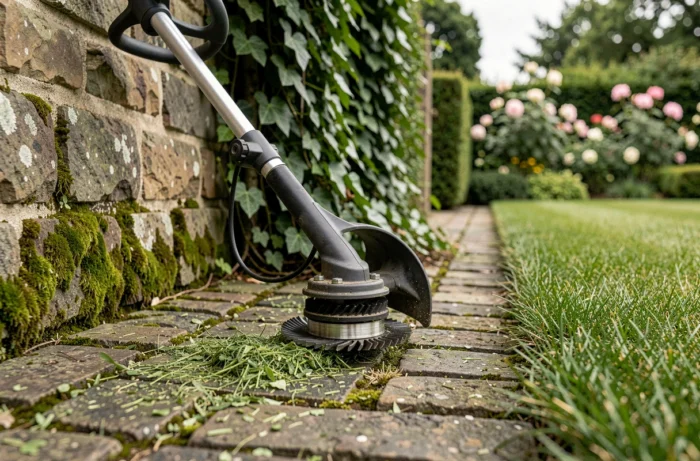
The cutting width determines the area covered with each pass. A wide cutting diameter speeds up work on long straight borders but makes precision work more difficult around flower bed bases or close to a stone edge.
- A narrow cutting head facilitates clean finishes along paving stones, walls, and concrete borders where every centimeter counts.
- A wide head is suitable for long stretches of lawn bordering paths, hedges, or fences without close obstacles.
- The diameter of the cutting line affects resistance against thick grasses: a thicker line slices through tough stems, while a thinner line provides a cleaner cut on soft grass.
Some models accept plastic or metal blades instead of line. These accessories increase cutting capacity on woody vegetation but can damage wooden or plastic borders upon contact.
Ergonomics and Maintenance: Two Criteria That Impact Longevity
A poorly balanced hedge trimmer fatigues the wrist and shoulder in just a few minutes. Three elements deserve to be tested before purchase:
- The adjustable auxiliary handle, which allows adapting the grip to the user’s size and the desired cutting angle (horizontal for the border, vertical for finishing).
- The telescopic tube, which prevents bending to reach the ground, especially on models designed to run along low flower beds or earth borders.
- The line replacement system: a quick-load head reduces interruptions, while a complex-to-dismantle spool discourages regular maintenance.
An ergonomic and easy-to-maintain tool will be used more often, which directly reflects on the neatness of the borders over the weeks. Purchasing a hedge trimmer is not a one-time investment: it is a choice that commits to several seasons of mowing and finishing, where the availability of parts and battery compatibility weigh as much as the power displayed on the box.