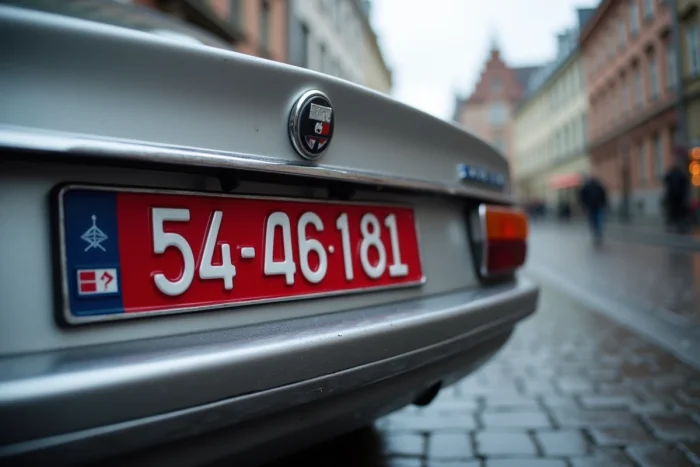
The standard Belgian license plate displays red characters on a white background. This color choice, often seen as a curiosity by French motorists, is based on administrative and technical decisions made throughout the 20th century. Here, we detail the reasons for this color code, its regulatory implications, and a rarely addressed angle: its impact on automatic reading systems at borders.
ANPR Reading and Belgian Red Plates: A Challenge for Automatic Recognition at Borders
The ANPR (Automatic Number Plate Recognition) cameras deployed at the French-Belgian borders and on European motorway networks have mostly been calibrated for plates with black characters on a white or light background. The black/white contrast offers an optimal luminance ratio for character segmentation algorithms.
The red-on-white combination of Belgian plates reduces this ratio. Red, in the visible spectrum, is closer to medium gray in monochrome conversion, complicating character extraction for systems operating in near-infrared or grayscale. We observe that Belgian plates generate a higher reading error rate than French or Dutch plates under the same lighting conditions.
This bias is not trivial. Speed control cameras, free-flow tolls, and low emission zone monitoring devices rely on ANPR reading. A vehicle registered in Belgium crossing a French LEZ may, in some cases, evade automatic fines if the system fails to read the plate. To learn more about the Belgian red plate explained, the specifics of the Belgian format deserve special attention.

This phenomenon reveals a cultural bias in the design of European road surveillance systems. The algorithms have been primarily trained on datasets from countries with black-on-white plates. Belgium, with its atypical format, represents a borderline case that exposes the shortcomings of incomplete standardization across the continent.
Origin of Red on White: Belgian Administrative Choice and National Colors
The link between the color of the plates and the Belgian national colors (black, yellow, red) seems obvious, but the administrative reality is more nuanced. The red of the plates was not chosen to represent the flag. It results from a series of regulatory decisions made by the Vehicle Registration Directorate (DIV).
The Belgian plate is assigned to a person, not a vehicle. This fundamental principle distinguishes the Belgian system from the French system (SIV), where the plate stays with the vehicle for life. In Belgium, an owner retains their registration number and transfers it from one vehicle to another. This personal attribution logic influenced the design: the plate had to be visually distinct from those of neighboring countries to avoid confusion during cross-border checks.
The choice of red on a white background emerged in the first half of the 20th century as a solution for readability by the naked eye, at a time when automatic reading did not exist. Red provided sufficient contrast in daylight conditions and was clearly distinguishable from French black plates or Dutch white plates.
Adaptation to European Format Since 2010
Since November 16, 2010, Belgium has adopted a wider plate format, aligned with European dimensions. The old plates, smaller and often square for 4×4 type vehicles, have gradually been replaced by a rectangular format of 52 x 11 cm for cars. The background remains white, the characters red, but a blue European band with the “B” symbol has appeared on the left.
This transition to the European format did not change the color code. Belgium has maintained its red/white combination while the majority of EU countries have converged towards black characters.
Types of Belgian Plates and Meaning of Special Colors
The standard red only covers a portion of the plates in circulation. The Belgian system uses several color codes to identify the nature of the vehicle or its use:
- Red on white: standard plate for private and business vehicles, the most common format in circulation
- Green on white: plate for national defense vehicles, also identifiable by a specific numbering format starting with “M”
- Blue on white: so-called “commercial” or “merchant” plates, intended for automotive professionals for vehicles in stock or testing
- Red on red background: temporary transit plates, often mistakenly confused with French transit plates (TT), but governed by a distinct Belgian regulatory framework
This diversity creates confusion for foreign motorists. A standard Belgian plate (red on white) is sometimes interpreted in France as a provisional or transit plate, whereas it is a permanent registration.
Numbering and Character Structure
The current system uses a combination of one digit, three letters, and three digits (format 1-ABC-123). The red letters and digits are printed in FE-Schrift, a font developed in Germany and adopted by several European countries to improve mechanical readability and reduce counterfeiting. This font limits confusion between similar characters (O and 0, I and 1).
Belgian Red Plate and Road Control in France: What the Regulations Say
A Belgian vehicle driving in France with its red-on-white plate is in a perfectly regular situation. No additional steps are required as long as the vehicle remains registered in Belgium and its driver does not establish their primary residence in France.
The obligation to re-register in France applies after establishing normal residence in French territory. The deadline starts from the date of establishment, and the vehicle must then obtain a French registration certificate and plates in the SIV format.
The French law enforcement agencies are trained to recognize standard Belgian plates, but confusion persists among the general public. The red characters are often associated with a temporary or diplomatic status, two incorrect interpretations. In France, red plates designate vehicles in temporary transit (TT) with a red background and silver characters, a format radically different from the Belgian plate.
The coexistence of these two color systems illustrates the absence of a unified chromatic standard in Europe for license plates. Each member state retains the freedom to define its own color codes, complicating cross-border reading for both humans and machines.