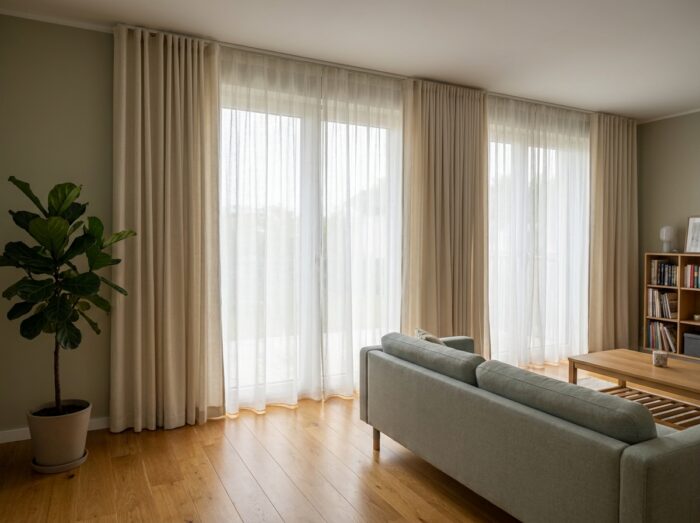
The solar protection of a home often boils down, in the collective mindset, to the roller shutters or hinged shutters installed on the facade. Interior devices (blinds, films, technical curtains) are seen as mere decorative accessories. Thermal and regulatory data tell a different story: the actual performance of a building against heat depends on the combination of both families of solar protection, not just one.
Solar factor and degree-hours: the indicators that measure solar protection
Comparing exterior shutters and interior protections without a measurement framework is akin to comparing two materials without knowing their conductivity. Two indicators structure the subject.
The solar factor (Sw) expresses the portion of solar energy that passes through the glazing + protection. The lower it is, the less heat enters. The RE2020 uses this indicator to calculate the summer comfort of a new home.
The indicator of discomfort degree-hours (DH) accumulates, over a typical year, the hours during which the indoor temperature exceeds a comfort threshold. It is this accumulation that the RE2020 caps to issue the building permit, not merely the presence of shutters.
| Criterion | Exterior protection (roller shutter, BSO) | Interior protection (blind, film, technical curtain) |
|---|---|---|
| Position relative to glazing | In front of the glass, facade side | Behind the glass, room side |
| Blocking of direct radiation | Very high (radiation does not reach the glazing) | Partial (the glazing has already absorbed part of the energy) |
| Management of natural light | Often binary (open/closed) except for BSO | Fine modulation (opacity, orientation of slats, gradual rolling) |
| Impact on ventilation | May hinder window opening depending on the model | Compatible with an open window |
| Maintenance and replacement | External intervention, sometimes at height | Simple replacement from the inside |
This table shows that each family excels on a different axis. Blocking radiation before the glass remains physically more effective for limiting heat. Modulating light without plunging the room into darkness is the domain of interior devices.

RE2020 and summer comfort: why exterior shutters are not always enough
The RE2020 imposes a summer comfort goal measured by degree-hours, but it does not systematically prescribe exterior protection. The project can combine building orientation, thermal inertia, ventilation, glazing quality, and interior solar protections to meet the regulatory threshold.
In other words, a home equipped with roller shutters on every window may fail the DH calculation if the inertia is low or if the openings are oversized. Conversely, a roller blind made of technical fabric combined with high-performance glazing can significantly contribute to the thermal balance of a northeast-facing room, where direct radiation remains limited.
The case of roof windows illustrates this complementarity well. The RE2020 applies particularly strict requirements to horizontal or gently sloped openings, as they receive more summer radiation. An interior blind alone is generally not sufficient for these openings, but the absence of any interior protection also degrades the result, even with an exterior shutter.
Interior solar protection in professional environments: a recent regulatory framework
Interior solar protection now extends beyond the scope of domestic comfort. Since July 1, 2025, decree n° 2025-482 requires employers to assess and prevent risks related to episodes of intense heat in indoor premises.
The measures provided may include the installation of blinds, solar films, or other devices limiting radiation. In an office building where the installation of exterior shutters is not feasible (glazed facade, architectural constraint, co-ownership), interior protection becomes the only variable for quick adjustment.
This decree changes the game for managers of tertiary buildings. Interior protections are no longer just an aesthetic choice: they contribute to a legal obligation for prevention.
When interior protection complements or replaces exterior protection
Three configurations frequently arise in technical arbitrations.
- Classified facades or those subject to the advice of the Architectes des Bâtiments de France often prohibit the addition of visible shutters or BSO from the street. A solar film on the glazing or an interior blind with a low solar factor remains the only feasible option without submitting a heavy request.
- Large west-facing windows receive low-angle radiation at the end of the day. A closed roller shutter blocks heat but eliminates all natural light during the hours when the room is occupied. An interior blind with adjustable slats filters radiation while maintaining brightness.
- Homes on higher floors or in converted attics, where exterior installation is technically challenging, benefit directly from a well-sized interior device combined with solar control glazing.
Combine rather than choose
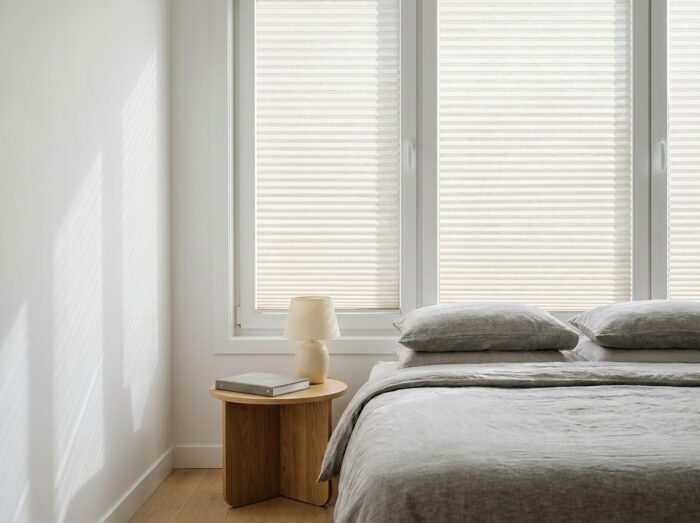
The binary reasoning (exterior or interior) overlooks the actual functioning of the building. Thermal performance depends on the glazing-protection pair, not on an isolated element. A roller shutter lowered on an old single glazing still lets in more heat than a technical blind placed behind solar control double glazing.
The RE2020 also reasons in terms of the overall solar factor of the opening, not by product type. What matters is the final Sw, regardless of the combination chosen.
Summer comfort in the DPE: an indicator to monitor
The energy performance diagnosis now includes a mention regarding summer comfort. Many homes display a correct energy label in winter but lack any effective solar protection for summer.
For a buyer or tenant, checking the presence and nature of solar protections (both interior and exterior) before signing becomes as relevant a reflex as reading the energy class. A home without a blind, film, or shutter on a south or west-facing facade accumulates discomfort degree-hours starting in June.
The data that summarizes the entire subject can be expressed in one sentence: thermal regulation measures an overall result, not a type of product. As long as the solar factor of the opening and the accumulation of degree-hours remain within limits, it does not matter whether the protection is interior, exterior, or both. Ignoring one of the two families amounts to depriving oneself of a measurable thermal lever.